
Mole, Seborrheic Keratosis & Skin Tag Removal with CO2 Laser by a Dermatologist

Moles, seborrheic keratoses, skin tags and other small bumps on the face and body are common concerns many people want removed, whether for confidence or because they sit in irritating spots, such as where they catch on collars or necklaces. CO2 laser allows dermatologists to remove these lesions with precision, leaving small wounds that heal quickly.
But before any removal, the most important step is knowing exactly what the lesion is.
How Does CO2 Laser Remove Skin Lesions?
CO2 (carbon dioxide) laser has a wavelength of 10,600 nm. Its energy is absorbed by the water in skin cells, vaporizing abnormal tissue layer by layer. This gives the doctor fine control over depth, removing only what is needed while minimizing impact on the surrounding healthy skin. The laser’s heat also seals small blood vessels, so there is very little bleeding during treatment.
What Can CO2 Laser Remove?
Moles (only those assessed by a doctor as having no abnormal features)
Dermatosis papulosa nigra: small brown or black spots on the face
Seborrheic keratosis: raised brown or black growths, more common with age
Skin tags: commonly found on the neck, underarms and eyelids
Warts on the hands, feet or face
Syringoma: small skin-coloured bumps under the eyes
Sebaceous hyperplasia: yellowish bumps with a central dip
Milia that cannot be extracted at home

Every Mole Must Be Examined by a Dermatologist First
This is the key reason mole removal should be done by a dermatologist: some moles are not ordinary moles. They may be early skin cancers, such as melanoma or basal cell carcinoma, which can look similar to a mole or seborrheic keratosis.
Laser removal destroys the tissue completely, leaving no sample for laboratory testing. If a cancer is lasered off unknowingly, diagnosis may be delayed and treatment becomes more difficult.
A dermatologist examines each mole with the naked eye and a dermoscope. If anything looks suspicious, a biopsy will be recommended instead of laser removal.
Warning signs of an abnormal mole (the ABCDE rule)
A – Asymmetry: irregular shape
B – Border: uneven or jagged edges
C – Color: multiple colours within one mole
D – Diameter: larger than 6 mm
E – Evolving: changes in size, colour or shape, bleeding or itching
The CO2 Laser Removal Process at The Derme Clinic
Assessment by a dermatologist: The lesion is identified through clinical examination, the specialist’s experience, or dermoscopy, and a treatment plan is made.
Cleansing and local anaesthesia: Numbing cream or a local anaesthetic injection is applied so the procedure is comfortable.
CO2 laser treatment: The doctor adjusts the energy to suit the size and depth of each lesion. It takes only a few minutes, depending on the number of spots.
Wound care: Ointment is applied and aftercare instructions are given before you go home.
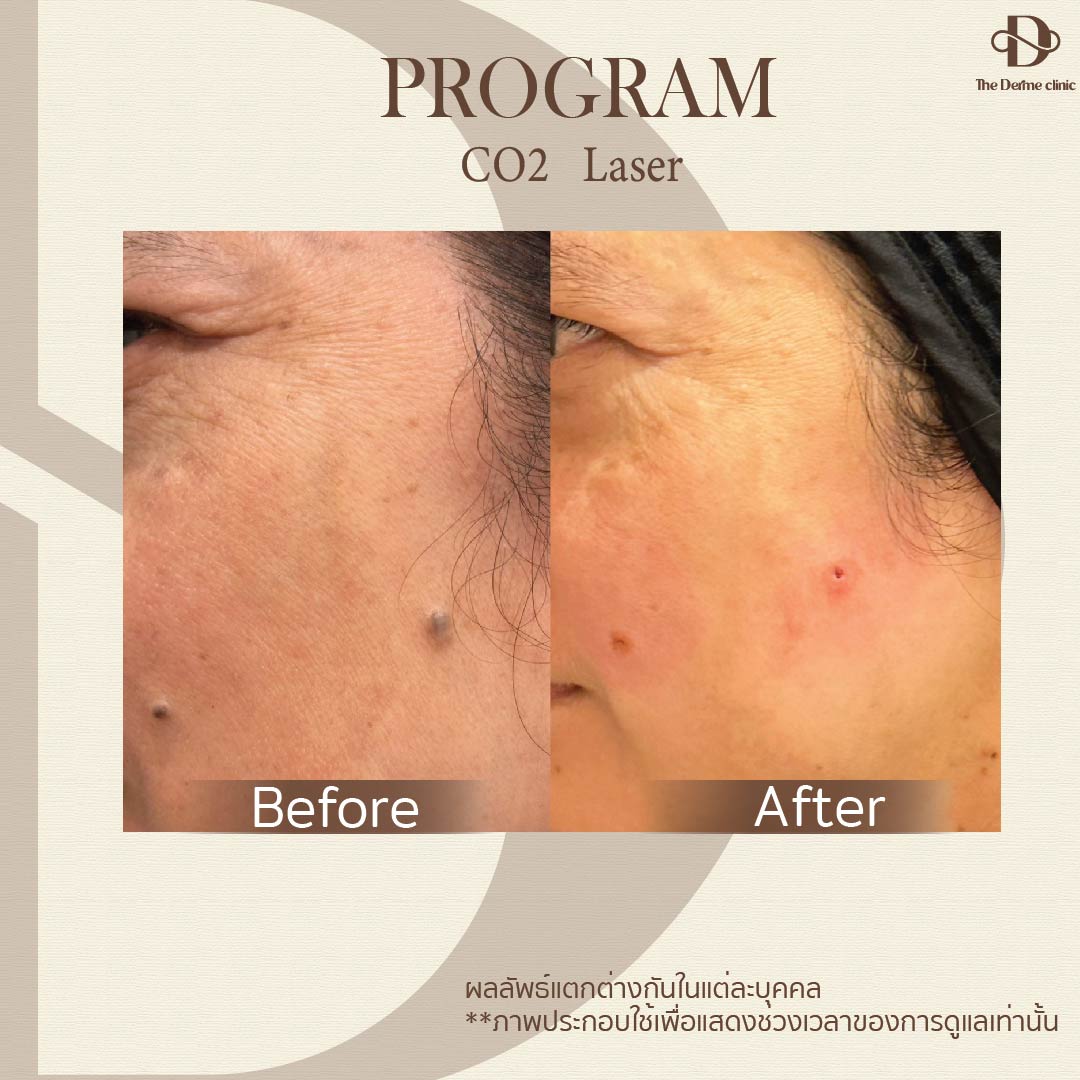
How Long Does It Take to Heal?
*Healing time varies from person to person, depending on the treatment approach, the size, depth and location of the lesion, and each individual’s body.
Aftercare
Keep the wound clean and apply ointment or cream as prescribed.
Do not pick or scratch the scab, to reduce the risk of scarring and dark marks.
Apply sunscreen daily once the wound has closed, and avoid strong sun.
Avoid makeup on the treated area until the wound has fully healed.
If the wound becomes swollen, red, increasingly painful or shows pus, please return to see the doctor.
Will It Leave a Scar? Possible Side Effects
Post-inflammatory hyperpigmentation (PIH): common in Asian skin and usually fades over time. Sun protection helps significantly.
Indented marks or scarring: possible, especially with deep or large lesions.
Recurrence: moles with deep roots may partially return, and warts, being caused by a virus, can recur. Some cases need repeat treatment.
Please inform your doctor if you: are pregnant, have a history of raised scars or keloids, have had herpes (cold sores) in the treatment area, or are taking isotretinoin for acne.
A dermatologist assesses the depth and chooses the most appropriate approach, aiming to remove the lesion completely while leaving as little trace as possible.
Why Choose a Dermatologist for Mole Removal?
Mole removal may seem like a simple procedure, but the real skill lies in accurate diagnosis before treatment and removing to exactly the right depth. Too shallow and the mole may return; too deep and there is a risk of scarring.
At The Derme Clinic, treatment is performed by Dr. Warittha Maitrisathit (Dr. Nan), a board-certified dermatologist with subspecialty training in Laser and Dermatologic Surgery, both certified by the Medical Council of Thailand.
Frequently Asked Questions
Does CO2 laser mole removal hurt?
A local anaesthetic is applied beforehand, so most people feel only mild warmth during the procedure.
How long does it take to heal?
*Healing time varies from person to person, depending on the treatment approach, the size, depth and location of the lesion, and each individual’s body. Your dermatologist will advise on the expected recovery after assessing your skin.
Will the mole grow back?
In most cases, no. Moles with deep roots may partially return and need repeat treatment, and warts can recur because they are caused by a virus.
Which moles should not be lasered?
Moles with abnormal features under the ABCDE rule, such as irregular borders, multiple colours, rapid growth or bleeding, should be examined by a dermatologist and may need a biopsy instead of laser removal.
Can several spots be removed in one session?
Yes. The doctor will assess the appropriate number and locations for each session.
